
Demolition robots: efficiency and safety in demolition
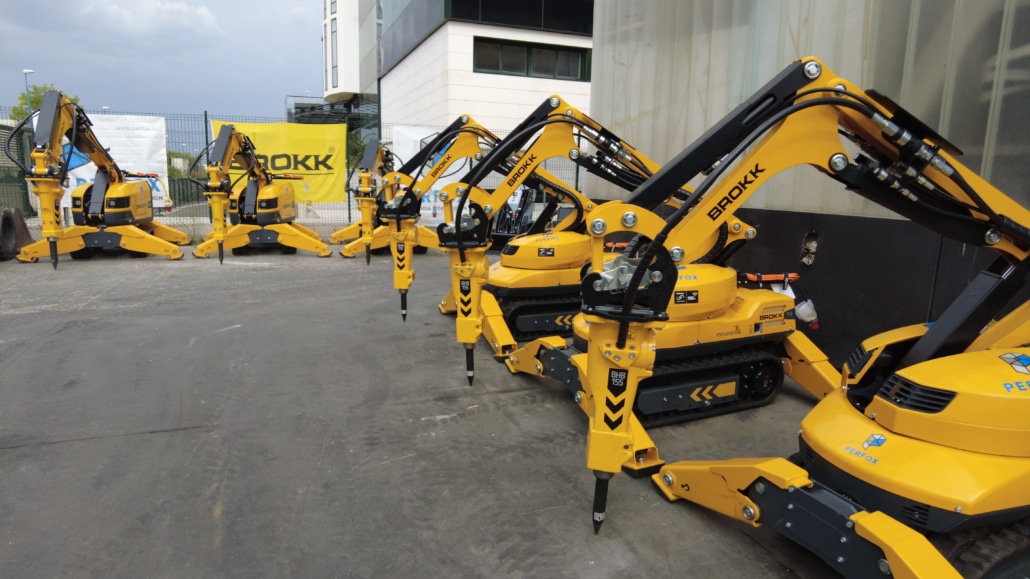
In the construction and demolition sector, technology continues to play a vital role, significantly improving safety and efficiency. In this regard, one of the most notable advancements in recent years is the introduction of demolition robots. These powerful, remotely controlled machines not only allow for more efficient demolition of structures but also contribute to raising safety standards for operators.
But what exactly is a demolition robot? Below we explain how they work, their advantages, and the future of remotely controlled demolition with robots.
What is a demolition robot?
A demolition robot is an advanced machine designed to carry out the controlled demolition of structures efficiently and safely. Designed to adapt to diverse environments and spaces, they are a highly versatile and precise solution for rehabilitation, restoration, and technical demolition work in the construction sector.
Its main function is to demolish buildings in a controlled manner, using remote control systems that allow operators to handle the machinery from a safe distance, which exponentially reduces the risks to workers compared to demolition using cabin robots or with an operator on board.
Advantages of demolition robots
Demolition robots offer multiple benefits for demolition projects, in which the use of electric machinery without a cabin is increasingly an essential requirement for project award, representing a solution to the growing demand for more efficient and safer demolition methods in the construction sector.
- Enhanced Security: Demolition robots allow operators to control machinery from a distance (Up to 300 meters, even more in special projects) which considerably reduces exposure to dangerous situations, such as in the event of a collapse. Thanks to this, worker safety improves, especially in potentially unstable environments.
- Precision and control: The possibility of operating the remote control for the demolition robot provides enormous precision when carrying out this type of tasks. Operators can maneuver the robot with great accuracy, without damaging surrounding areas or elements that need to be preserved.
- Operating efficiency: Demolition robots allow for much better optimization of both time and resources. Its ability to access places that are difficult to reach, whether due to space limitation or confinement, and execute demolition tasks quickly and controlled by a single operator accelerates the entire process, reducing personnel costs and project deadlines.
- Adaptability to various environments: Demolition robots are designed to adapt to a wide variety of structures, environments, temperatures, amount of dust and vibrations, which makes them ideal for demolition tasks in difficult conditions. extreme, thanks to their different sizes, powers and resistance in structure and hoses that may be complex or impossible for manual demolitions.
The future of controlled demolition with remote robots
In recent years, the controlled demolition sector has undergone a major transformation, and remotely operated robots have played a significant role in this change. The future of controlled demolition with remotely operated robots promises not only greater efficiency but also a revolution in terms of safety and sustainability.
Constant innovation in remote control technology for demolition robots is paving the way for more precise and intelligent methods. Thanks to the combination of advanced sensors, artificial intelligence, and machine learning algorithms, these robots are increasingly capable of adapting to diverse situations and delivering improved performance.
Thus, it is expected that, in a few years, demolition robots will not only be controlled remotely, but will also be able to make independent decisions based on advanced algorithms, analyzing the structure of the building, identifying key points and executing the demolition in a manner autonomous, security is increased.
In short, demolition robots represent a significant evolution in the construction and demolition sector. The ability to operate them remotely improves operational efficiency and raises safety standards. Furthermore, they hold the promise of a safer, more sustainable, and more efficient future.
9/01/2024

