What is concrete hydrodemolition and what does it consist of?
When concrete structures require repair, conditioning, restructuring or demolition, we can currently resort to two types of solutions: demolition by percussion or hydrodemolition.
Unlike traditional methods, which can be more aggressive and cause collateral damage, hydrodemolition uses high-pressure water to break down concrete. This significantly reduces the risk of damaging steel reinforcement and the dispersion of dust and debris, making it a cleaner and safer option. It is especially recommended for sensitive projects such as bridges, tunnels, and historical structures.
What is hydrodemolition?
Hydrodemolition is a modern and highly effective technique that allows for the controlled and precise removal of deteriorated or unwanted concrete. This method has gained popularity in recent years thanks to its ability to maintain the integrity of underlying structures while removing the target material.
This technique emerged as an alternative to traditional demolition methods, such as hammering or the use of explosives, which often caused collateral damage, as well as additional risks to workers and the environment. Furthermore, over time it has evolved thanks to technological advances, allowing for increasingly greater control and precision.
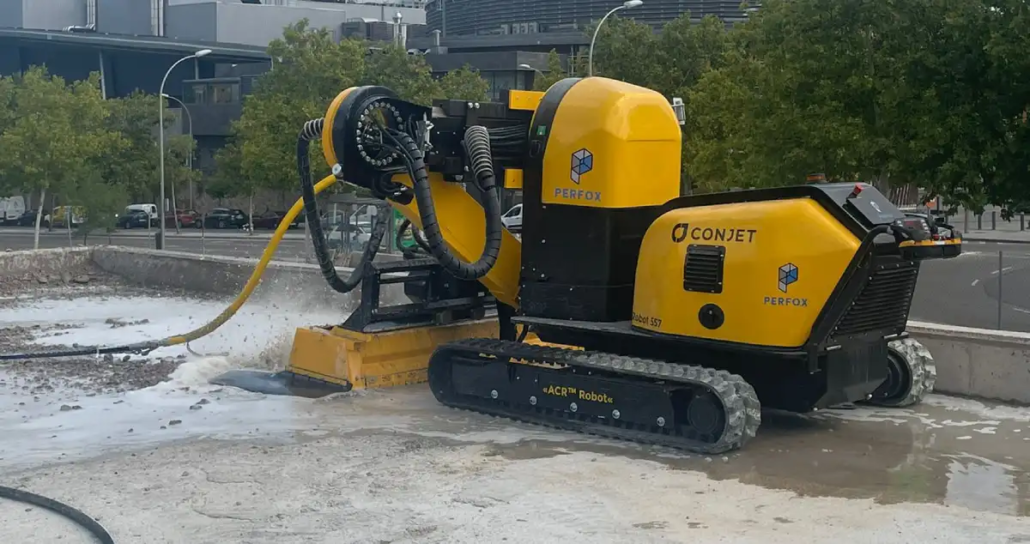
Through a specialized machine, the water is projected with such force that it is capable of breaking the concrete, but in a controlled manner and without affecting the structural elements that must be preserved.
Typically, this type of equipment includes high-pressure pumps, remote-controlled robots, and nozzle systems that direct the water jet. It can be adjusted to change the pressure and flow of water depending on the type of concrete and the level of deterioration.
What is hydrodemolition used for?
Thanks to its ability to selectively and precisely remove concrete, hydrodemolition has a wide variety of applications within the construction and infrastructure rehabilitation sector.
Bridge rehabilitation
One of the most common uses of hydrodemolition is in the rehabilitation of bridges. Over time, concrete on bridges can deteriorate due to exposure to the elements and constant traffic. This technique allows damaged sections to be removed without damaging the bridge structure, facilitating repair and prolonging its useful life.
Restoration of historic structures
Hydrodemolition is also used to restore historic buildings without causing damage to the sections that need to be preserved. Especially useful for removing layers of concrete added in previous renovations that are not compatible with the original materials.
Preparation of surfaces for new concrete layers
Another common application is the preparation of surfaces for the addition of new layers of concrete. Hydrodemolition can create a rough, clean surface, ideal for ensuring good adhesion between new and existing concrete. This is crucial to ensure the durability and integrity of the repair.
Advantages of hydrodemolition
Hydrodemolition offers multiple advantages over traditional percussion demolition in the construction industry:
Preservation of structural integrity
By using high-pressure water, the risks of damage to the reinforcing bars are reduced and cracking of the concrete is prevented, thus preserving the integrity of the structure. This is crucial, for example, on bridges and historic buildings, where traditional demolition could cause irreparable damage.
Environmental Impact Reduction
Compared to percussion demolition, hydrodemolition generates significantly less dust and debris . In addition to reducing airborne particles, using water to break down concrete also improves working conditions, reduces health risks for operators, and simplifies waste management and disposal. This allows the project to comply with environmental sustainability regulations.
Precision and control
Hydrodemolition allows for precise adjustment of water pressure and flow, enabling fully controlled concrete removal. This is crucial in projects where specific parts of the structure need to be preserved or where work is required in confined spaces.
Enhanced Security
By eliminating the use of heavy hand tools and explosives, hydrodemolition reduces the risk of accidents. Additionally, reduced vibrations and noise levels provide a more comfortable and safer work environment for operators, thus improving productivity and well-being in the workplace.
How is hydrodemolition carried out?
The hydrodemolition process includes several key phases that ensure a more efficient and controlled selective material removal process.
site preparation
Before starting the work, it is necessary to carry out an in-depth evaluation of the face to be hydrodemolished, to identify which areas require action and to what extent in each of them. This includes everything from visual inspections to the use of scanning technology to determine the level of concrete deterioration.
Equipment configuration
Once you have identified the areas to be treated, it is necessary to configure the hydrodemolition equipment, adjusting the water pressure in the high-pressure pumps and selecting the appropriate nozzles for the type of concrete and the type of demolition required. Robots can be programmed to follow specific trajectories, ensuring that selective material removal is more precise and uniform.
Execution of the process
During the process, high-pressure water is projected onto the concrete, penetrating it and disintegrating it without damaging the reinforcing bars or surrounding structures. Operators must constantly monitor the process, having the option to adjust parameters when necessary and ensure that project objectives are met.
Cleaning and waste management
Once the hydrodemolition is completed, the site must be thoroughly cleaned to remove any remaining concrete and residual water. Containment and filtration systems ensure that waste is handled in a safe and environmentally friendly manner.
Inspection and completion
Finally, a check is carried out to verify that the deteriorated concrete has been completely removed and that the surface is prepared to carry out any repair or rehabilitation work. Fundamental to guarantee the quality and durability of the repairs carried out.
At Anzeve , we are leaders in specialized machinery. Thanks to our collaboration with CONJET AB, developers of high-pressure robotic equipment, we can offer you advanced hydrodemolition technology that not only improves productivity but also helps reduce environmental impact and ensures a safe working environment.
Trust our experience to make your construction and rehabilitation projects more efficient!
2/07/2024

